
Share Your Ideas
TheThinkLad is an open blogging platform where anyone can write articles and share their story with the world. Write with us.
TheThinkLad is an open blogging platform where anyone can write articles and share their story with the world. Write with us.
Artificial Intelligence has evolved rapidly over the past few years. While tools like ChatGPT, GitHub Copilot, and Claude introduced millions of people to conversational AI, the next major shift is already happening: AI Agents.

Manjil Koirala
Jul 11, 2026
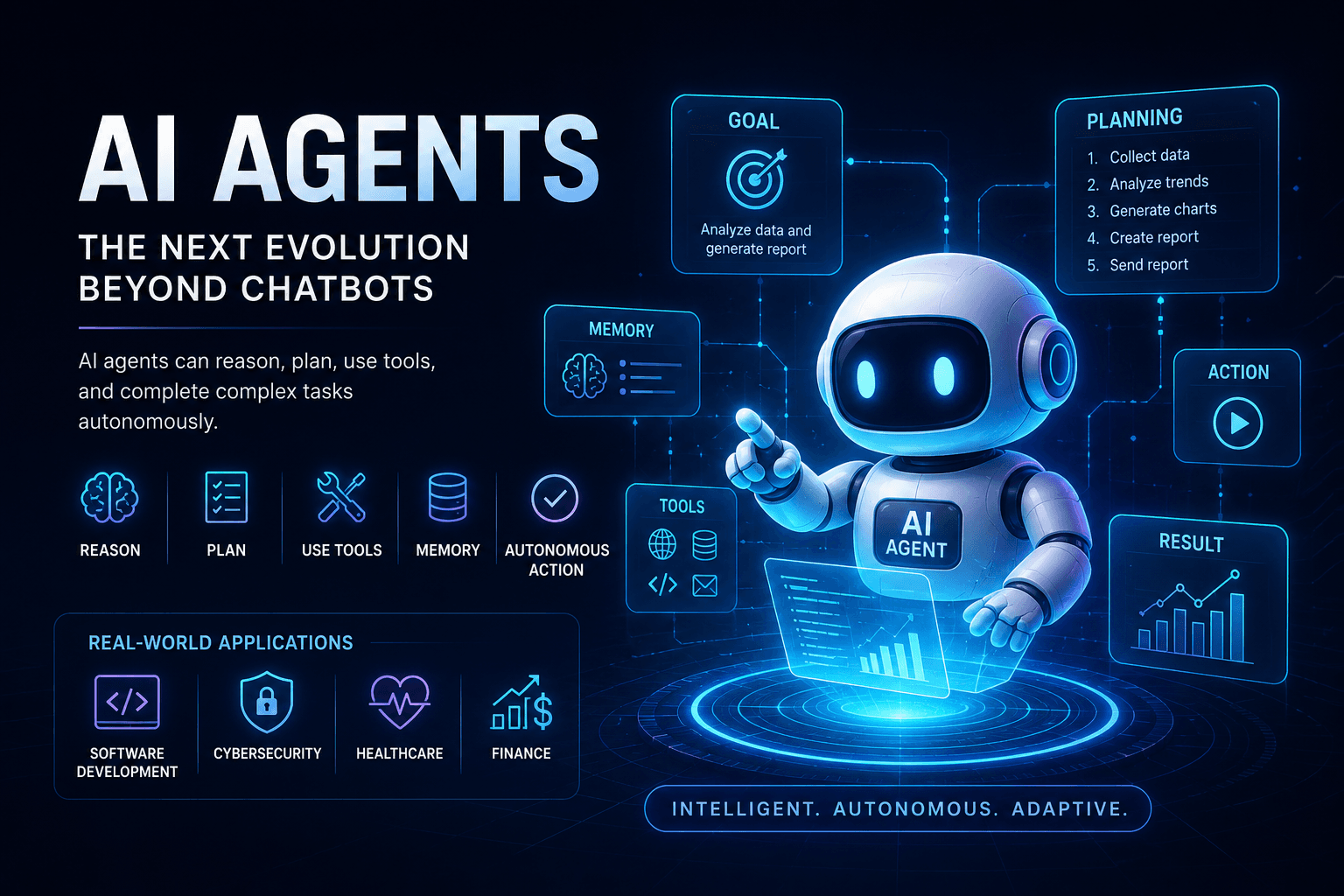
Artificial Intelligence has evolved rapidly over the past few years. While tools like ChatGPT, GitHub Copilot, and Claude introduced millions of people to conversational AI, the next major shift is already happening: AI Agents.
Unlike traditional chatbots that simply respond to prompts, AI agents can reason, plan, use external tools, remember context, and complete complex tasks with minimal human intervention.
This transition is changing how software is built, how businesses operate, and how developers think about automation.
An AI agent is an intelligent system capable of:
Understanding goals instead of individual prompts
Breaking complex problems into smaller tasks
Making decisions during execution
Using external tools and APIs
Maintaining memory and context
Completing multi-step workflows autonomously
Instead of asking:
"Write me a SQL query."
You can ask:
"Analyze our sales database, identify declining products, generate charts, create a report, and email it to management."
The agent determines how to accomplish the task, choosing the appropriate tools and executing each step until the objective is complete.
Traditional AI | AI Agent |
|---|---|
Responds to a single prompt | Works toward an overall goal |
No planning | Plans multiple steps |
Limited memory | Maintains context and memory |
Cannot use external tools | Uses APIs, databases, and applications |
Human controls every step | Executes tasks with minimal supervision |
Think of traditional AI as a calculator.
Think of AI agents as digital employees capable of completing real work.
A typical AI agent follows a continuous reasoning loop:
User Goal
    │
    ▼
Reason
    │
    ▼
Plan
    │
    ▼
Select Tool
    │
    ▼
Execute Task
    │
    ▼
Evaluate Results
    │
    ▼
Goal Achieved
If something goes wrong, the agent adapts, revises its plan, and continues working until the goal is completed.
The LLM serves as the brain of the agent. It understands natural language, reasons through problems, generates plans, and makes decisions.
Popular models include:
GPT-5
Claude
Gemini
Llama
Memory allows AI agents to retain useful information instead of starting from scratch every time.
There are three common types:
Short-term Memory: Stores the current conversation or active task.
Long-term Memory: Stores previous interactions, preferences, and historical knowledge.
Working Memory: Holds temporary information while solving complex tasks.
One of the biggest advantages of AI agents is their ability to interact with external systems.
Examples include:
Databases
REST APIs
GitHub
Google Calendar
Slack
Cloud services
Search engines
Rather than generating fictional information, agents retrieve live data and interact with real systems.
Before taking action, AI agents generate an execution plan.
For example:
Goal
Generate a weekly sales report.
Execution Plan
1. Retrieve sales data
2. Calculate weekly revenue
3. Compare with previous week
4. Generate charts
5. Write summary
6. Email report to management
Planning enables agents to solve complex problems systematically.
Advanced AI agents evaluate their own work before presenting the final result.
They may ask themselves:
Is the answer accurate?
Did every step complete successfully?
Should another tool be used?
Can this solution be improved?
Reflection significantly increases reliability and reduces errors.
AI agents can:
Generate code
Review pull requests
Detect bugs
Execute automated tests
Write documentation
Deploy applications
Developers spend less time on repetitive tasks and more time solving business problems.
AI agents are becoming increasingly valuable in cybersecurity.
They can:
Monitor network traffic
Detect suspicious behavior
Correlate security logs
Investigate alerts
Recommend incident response actions
Generate security reports
While human analysts remain responsible for final decisions, AI agents dramatically reduce investigation time.
Healthcare organizations use AI agents for:
Appointment scheduling
Clinical documentation
Medical summarization
Diagnostic support
Treatment recommendations
Human oversight remains essential because patient safety is critical.
Financial institutions leverage AI agents for:
Fraud detection
Risk analysis
Portfolio monitoring
Automated reporting
Customer support
Although AI agents are powerful, they still face important challenges.
AI agents may confidently generate incorrect or misleading information.
Validation mechanisms are essential, especially in high-risk environments.
Providing AI agents with access to APIs, cloud infrastructure, or databases increases security risks.
Developers should implement:
Authentication
Authorization
Input validation
Audit logging
Rate limiting
Following the principle of least privilege is crucial.
Every reasoning step consumes tokens and computational resources.
Complex workflows may require dozens of AI model calls, making optimization important for production environments.
AI agents frequently process sensitive information.
Organizations should carefully manage:
Data encryption
Access controls
Data retention policies
Regulatory compliance
User consent
When developing AI agents, consider the following best practices:
Keep humans involved in critical decisions.
Limit permissions using the principle of least privilege.
Validate all AI outputs before executing important actions.
Log every tool invocation for auditing.
Separate reasoning from execution.
Design modular prompts.
Cache frequently used information.
Monitor latency and token usage.
We are transitioning from AI systems that simply answer questions to intelligent systems capable of completing meaningful work.
Future AI agents will:
Collaborate with other AI agents
Continuously improve from experience
Understand enterprise knowledge
Execute long-running workflows
Operate across multiple platforms simultaneously
Rather than manually interacting with numerous applications, users will simply describe the desired outcome, and AI agents will determine how to achieve it.
AI agents represent one of the most significant advancements in modern artificial intelligence. By combining reasoning, planning, memory, and tool integration, they move beyond simple conversations and become capable of solving real-world problems autonomously.
For developers, understanding AI agents is becoming just as important as learning cloud computing, APIs, or databases. As organizations increasingly adopt autonomous systems, the demand for engineers who can design, secure, and deploy AI agents will continue to grow.
The future of software is no longer just about writing code—it is about building intelligent systems that can think, collaborate, and act responsibly. Those who begin exploring AI agents today will be well-positioned for the next generation of software engineering and technological innovation.



Article Reactions
Reflections (0)